f The Wittenberg Door: April 2011

Photobucket - Video and Image Hosting
My Photo
Name:

Commenting on Christendom, culture, history, and other oddities of life from an historic Protestant perspective.

Saturday, April 30, 2011

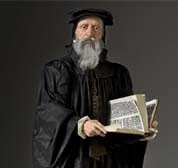
Notable Quote: John Calvin

John Calvin (1509 – 1564) on contending vigorously against the devil . . .

The fact that the devil is everywhere called God’s adversary and ours ought to fire us to an unceasing struggle against him. For if we have God’s glory at heart, as we should have, we ought with all our strength to contend against him who is trying to extinguish it.

Labels:

Friday, April 29, 2011

Thought of the Day: Assurance

There are two aspects to the assurance of salvation: one is objective in nature and the other is subjective. Our assurance is objective in that the believer’s salvation is secured and guaranteed by God. The subjective aspect is psychological in nature, so it can be adversely affected by the on-going struggle with sin. Another way to put it is that I know that I’m saved, but sometimes I don’t feel that I am.

Labels: ,

Thursday, April 28, 2011

General Revelation – Part 4 - The Inadequacy of General Revelation (Conclusion)

In the last post on this topic we discussed the effects of the Fall upon man’s religious self. We also considered the difference between how regenerate and unregenerate man responds to General Revelation. And finally we saw the result of unregenerate man’s response—judgment.

In this post we’ll take a look at the way in which General Revelation falls short in bringing us a full knowledge of God.

The “Generalness” of General Revelation

As the name indicates, General Revelation is general. It is limited, and that intentionally so. Although limited, it has never failed, always accomplishing it’s purpose: revealing to us God’s eternal power and deity, and revealing to us our own guilt and pending judgment. Its purpose is further established by what it does not do—it does not take the place of, nor minimize the need for, Special Revelation (more about this in future posts).

General Revelation is insufficient to reveal to us the particulars of God’s will.

In the garden, prior to the Fall, God revealed the particulars of His will to Adam verbally. God told Adam to . . .

  • “Be fruitful and multiply…” (Genesis 1:28)

  • Subdue the earth and take dominion over the animals (Genesis 1:28)

  • Not eat of the tree of the knowledge of good and evil (Genesis 2:17)

Sin affects the way we perceive, interpret, and act upon General Revelation

Believers and unbelievers share the same laws of thought (the fall was ethical, not metaphysical). However, the use of the laws of thought are different: the sinner uses the laws of thought in a way that is contrary to the glory of God; believers, on the other hand, use the standards of logic to glorify God, submit to Him, and serve Him. Consequently, logic does not provide a neutral, common ground for the arbitration of the truth. Thus, because of the Fall, our thinking about God’s creation is distorted without His gracious intervention.

General Revelation does not reveal to us the particulars of God’s nature

Do not misunderstand: The sinner “knows” God—the one, true, and living God—and rejects Him (Romans 1:18-22). But creation does not reveal to us the ontological Trinity, the dual nature of Christ, the virgin birth, ect.

General Revelation does not reveal Christ to us

God’s “invisible attributes are clearly seen, being understood by the things that are made” (Romans 1:20). Indeed, God’s love, grace, and mercy are displayed in His providential care for humanity, providing “us rain from heaven and fruitful seasons, filing our hearts with food and gladness” (Acts 14:17); and in providing His law to us innately (Romans 2:14-15), thus enabling man to establish civilizations.

Conclusion

We were created to worship Him (Psalm 45:11), to have communion with Him (Genesis 3:8-9), to dwell with Him (Psalm 23:6; Westminster Shorter Catechism, Q&A #1). But as we discussed in earlier posts, we know that we are guilty and separated from God. We know that we are lawbreakers. We know that He is holy and we are not—a great chasm exists that we cannot cross, and General Revelation provides no bridge.

General Revelation has, however, accomplished, and is accomplishing, its work: God’s power and deity is declared, and man’s judgment is made known. Through all the earth, through all time, no one escapes this knowledge. God has actively disclosed this information to mankind, and mankind remains unthankful, rebellious, and guilty (Romans 1:17). God’s judgment is sure. Man is lost.

But the story does not end there! There remains a glorious truth that has yet to be uncovered: a bridge across a chasm that we could previously not traverse.

In the next post on the topic of revelation we’ll discuss Special Revelation.

Labels: ,

Wednesday, April 27, 2011

General Revelation – Part 3 – The Antithesis

In Part 2 we learned that God has revealed Himself through man’s moral reasonings and moral self. We also discovered that because of the Fall the object of man’s worship has changed.

The Effects of the Fall

The effects of the fall upon man’s religious-self are evident. We are by nature idolaters (Exodus 32). What is the result of our idolatry? False gods. These false gods are always the antithesis (opposite) of the True God—as are their resulting religions. Consider the following about non-Christian religions:

  • Works based


  • Exalts man


  • Presents a god that is strikingly similar to man


  • Presents a god who can be completely conceptualized


  • Is contradictory


  • Cannot be established (consider Anslem’s dictum: the contrary to the truth can never be demonstrated)

Response: The Antithesis

  • How does regenerate man respond? By giving praise to the Creator.


  • How does unregenerate man respond? By ignoring and distorting General Revelation.

...although they knew God, they did not glorify Him as God, nor were thankful, but became futile in their thoughts, and their foolish hearts were darkened. Professing to be wise, they became fools, and changed the glory of the incorruptible God into an image made like corruptible man—and birds and fourfooted animals and creeping things.

Romans 1:21-23

Result: Judgment

…And being thus become wicked, perverse, and corrupt in all his ways, he has lost all his excellent gifts which he had received from God, and retained only small remains thereof, which, however, are sufficient to leave man without excuse…

(The Belgic Confession, Article 14)

But although we lack the natural ability to mount up unto the pure and clear knowledge of God, all excuse is cut off because the fault of dullness is within us. And, indeed, we are not allowed thus to pretend ignorance without our conscience itself always convicting us of both baseness and ingratitude.

John Calvin, Institutes of the Christian Religion

As the Belgic Confession and Calvin remind us, God has clearly revealed Himself in creation, both internally and externally. Thus man has no excuse. This fact is further established in Romans 1:18-20. Sinful man, however, continues to curse God using the breath graciously provided by the Creator—“…although they knew God, they did not glorify Him as God, nor were thankful…” (Romans 1:21) As a result, God in His supreme justice “gave them up to vile passions.” (Romans 1:26) In so doing, God sovereignly allows those under judgment to peruse their wickedness.

For the elect’s sake, however, God restrains man’s wickedness (2 Ths. 2:7)—man is not as bad as he could be. God’s restraint is analogous to a man grabbing, from behind, the shirt of another man who is trying to run off a cliff.

To be continued . . .

Labels: ,

Tuesday, April 26, 2011

General Revelation – Part 2 – Internal Revelation

In my last post on this topic, we discovered that God reveals Himself to all men through the created order. In this post we’ll see that God also reveals Himself to all men internally.

18) For the wrath of God is revealed from heaven against all ungodliness and unrighteousness of men who suppress the truth in unrighteousness,

19) because that which is known about God is evident within them; for God made it evident to them.

20) For since the creation of the world His invisible attributes, His eternal power and divine nature, have been clearly seen, being understood through what has been made, so that they are without excuse.

Romans 1:18-20

It is not of a mere external revelation of which the apostle is speaking, but of that evidence of the being and perfections of God which every man has in the constitution of his own nature, and in virtue of which he is competent to apprehend the manifestation of God in his works.

Charles Hodge (1797–1878)

God Reveals Himself to Us Through Our Moral Reasonings

Conversation with an unbeliever: Ever feel guilty? Of course you do. Why? Because you are guilty. Guilty of what? Of breaking God’s law.

It would be rare indeed to find someone in this country who has not heard the summary of God’s law—the Ten Commandments. But what of those who have not heard? Are they off the hook? Do they receive a cosmic “Get Out of Jail Free” card? Many Evangelicals would say yes. Many would say that surly God would not find someone guilty of breaking a law that he did not know.

But is this the case? Is one excused from the law’s requirements simply because he’s never heard them? Paul addresses this issue in Romans, stating “for when Gentiles, who do not have the law, by nature do the things in the law . . . show the work of the law written in their hearts, their conscience also bearing witness, and between themselves their thoughts accusing or else excusing them” (Romans 2:14-15). In his commentary on Romans, John Calvin speaks of men being “blind,” but “not so blind that we can plead ignorance without being convicted of perversity.”

The actual hearing of the law does not determine the lawbreakers ultimate guilt; for all men know the law of God innately, since all men bear the image of God (Genesis 1:26-28). Thus, when men reason morally, experience a crises of conscience, or suffer from guilty feelings they are actually reflecting the stamp of the law, which each man by nature bears.

All men of sound judgment will therefore hold, that a sense of Deity is indelibly engraven on the human heart. And that this belief is naturally engendered in all, and thoroughly fixed as it were in our very bones, is strikingly attested by the contumacy of the wicked, who, though they struggle furiously, are unable to extricate themselves from the fear of God . . . for the worm of conscience, keener than burning steel, is gnawing them within.

John Calvin (1509-1564)

God Reveals Himself to Us Through Our Religious Self

As much as man is a moral creature, he is just as much a religious creature. Man was created to have fellowship with, to worship, and to adore his Creator.

Q. 1. What is the chief end of man?
A. Man’s chief end is to glorify God, and to enjoy him forever.

Westminster Shorter Catechism (1640s)

Then all your people will be righteous; they will possess the land forever, the branch of My planting, the work of My hands, that I may be glorified.

Isaiah 60:21

For from Him and through Him and to Him are all things To Him be the glory forever. Amen.

Romans 11:36

The Fall, however, changed the object of man’s worship:

. . . although they knew God, they did not glorify Him as God, nor were thankful, but became futile in their thoughts, and their foolish hearts were darkened. Professing to be wise, they became fools, and changed the glory of the incorruptible God into an image made like corruptible man—and birds and fourfooted animals and creeping things.

Romans 1:21-23

Instead of accepting revelation they became philosophers. And what is a philosopher? A philosopher is a man who claims that he starts by being skeptical about everything, that he is an agnostic. “I am going to have the date,” he says, “and then I am going to work it out.” And that is exactly what such men have done; they become foolish and wicked in their reasonings, in their thoughts, in their own conjectures and speculations and surmisings. And what is the cause of it all? Paul uses the word “vain” and it means not only foolish, but it means wicked as well . . . The cause of the whole trouble was wickedness and it is still wickedness.

D. Martin Lloyd-Jones (1899-1981)

To be continued . . .

Labels: ,

Monday, April 25, 2011

General Revelation – Part 1 – External Revelation

The heavens declare the glory of God; And the firmament shows His handiwork.

Psalm 19:1

We know Him by two means: First, by the creation, preservation, and government of the universe; which is before our eyes as a most elegant book, wherein all creatures, great and small, are as so many characters leading us to see clearly the invisible things of God, even his everlasting power and divinity, as the apostle Paul says (Rom. 1:20). All which things are sufficient to convince men and leave them without excuse.

Belgic Confession, Article 2 (1561)

To speak of General Revelation is to speak of God making Himself known (i.e., revealing Himself) to all people everywhere. This revelation is twofold:

  • The external revelation of God in nature

  • The internal revelation of God in man

External Revelation

God reveals Himself to us through the created world

As we look around us, the evidence of our Creator is everywhere. Consider how fine-tuned the universe is to support human life (anthropic principle); or how amazing it is that Microchiroptera bats can hunt in total darkness by emitting a stream of high-pitched sounds that bounce off their prey and then the resulting echo is received by their very sensitive antennas; or how about the bacterial flagellum with it’s out-board-motor-like propulsion system—complete with a rotor, O-rings, bushings, and drive shaft. Indeed, we live in a world filled with wonders that evidence our loving Creator.

For since the creation of the world His invisible attributes are clearly seen, being understood by the things that are made…

Romans 1:20

God’s creative handiwork is clearly evident to all. Expounding on this point, Paul, speaking to the people of Lystra, said,

Nevertheless He did not leave Himself without witness, in that He did good, gave us rain from heaven and fruitfhttp://www.blogger.com/img/blank.giful seasons, filing our hearts with food and gladness.

Acts 14:17

To be continued with Internal Revelation . . .

Labels: ,

Saturday, April 23, 2011

Notable Quote: Augustine


Augustine (354 – 430) on keeping the Lord’s commands . . .


When you aim at the perfect standard of holiness, you should, at your best moments, and in your highest attainments, fall so far below it; seeing indeed the way before you, but feeling yourself without ability to walk in it? Then let a sense of your helplessness for the work of the Lord lead you to the throne of grace, to pray, and watch, and wait, for the strengthening and refreshing influences of the Spirit of grace. Here let your faith realize at one and the same view your utter insufficiency, and His complete All-sufficiency....We might as soon create a world, as create in our hearts one pulse of spiritual life. And yet our inability does not cancel our obligation. What then remains for us, but to return the mandate to heaven, accompanied with an earnest prayer, that the Lord would write upon our hearts those statutes, to which He requires obedience in His word?, "You have commanded us to keep Your statutes diligently." We acknowledge, Lord, our obligation; but we feel our impotency. Lord, help us: we look unto You. "Oh that our ways were directed to keep Your statutes!" "Give what You command—and then command what You will.

HT:

Labels:

Thursday, April 21, 2011

A Protestant, a Priest, and a Televangelist Walk Into a Bar . . .

A Protestant minister, a Roman Catholic priest, and a televangelist are in a bar discussing how much of the offering they should keep.

The Protestant says, “I draw a line in the sand, and then throw the money into the air. The money that lands on my side of the line I keep, and the rest I give back to the Lord.”

The priest said, “I do something similar, except I draw a circle. The money landing in the circle is mine, and the rest is the Lord’s.”

Finally, the televangelist offers his view: “My method is far easier and more God honoring. I simply throw the money into the air and let the Lord pluck-out what he wants.”

Labels:

Wednesday, April 20, 2011

Thought of the Day: Election

Those claiming that election is based upon God “looking down the corridors of time” make Him into a mere prognosticator—a cosmic Madam Cloe who’ll tell your future for just $2.99 a minute.

Labels: ,

Tuesday, April 19, 2011

Lord, Awake Faith!

From Valley of Vision: A Collection of Puritan Prayers:

My God, I bless Thee that Thou hast given me the eye of faith, to see Thee as Father, to know Thee as a covenant God, to experience Thy love planted in me; for faith is the grace of union by which I spell out my entitlement to Thee: faith casts my anchor upwards where I trust in Thee and engage Thee to be my Lord.

Be pleased to live and move within me, breathing in my prayers, inhabiting my praises, speaking in my words, moving in my actions, living in my life, causing me to grow in grace.

Thy bounteous goodness has helped me believe, but my faith is weak and wavering, its light dim, its steps tottering, its increase slow, its backslidings frequent; it should scale the heavens, but it lies grovelling in the dust. Lord, fan this diving spark into glowing flame. When faith sleeps, my heart become an unclean thing, the fount of every loathsome desire, to cage of unclean lusts all fluttering to escape, the noxious tree of deadly fruit, the open wayside of earthly tares.

Lord, awake faith to put forth its strength until all heaven fills my soul and all impurity is cast out.

HT: Soli Deo Gloria

Labels:

Sunday, April 17, 2011

Today in Church History: Archibald Alexander, Princeton Theological Seminary

On April 17, 1772, Archibald Alexander was born near Lexington, Virginia.

Educated at Liberty Academy (now Washington and Lee University) and ordained in 1794, Alexander was president of Hampden-Sydney College and served as pastor of Third Presbyterian Church in Philadelphia for six years. In 1812, the General Assembly appointed him the first faculty member of the newly created Princeton Theological Seminary. As "Professor of Didactic and Polemic Theology," he would soon be joined by Samuel Miller and Charles Hodge, and eventually by two of his sons, James Waddel Alexander and Joseph Addison Alexander, as well. He would serve at Princeton until shortly before his death in 1851.

Born of second-generation Scotch-Irish parents and converted through frontier revivals in the Shenandoah Valley, Alexander always considered Virginia his home. Although he was an opponent of the excesses of revivalism, he insisted on the importance of the experiential dimension of the Christian life, especially in his 1841 book, Thoughts on Religious Experience.

John Muether

Labels:

Thursday, April 14, 2011

Today in Church History: Westminster Assembly of Divines

On April 14, 1648, the Westminster Assembly of Divines presented its Catechisms to Parliament: the Larger Catechism for pulpit exposition and the Shorter Catechism for the education of children.

When the 121 divines convened in 1643, they set out at first to review the Anglican -Nine Articles of Religion, which was considered essentially but not sufficiently Calvinistic. Soon the work of the Assembly expanded, and five years and 1,163 sessions later, it produced the Westminster Confession of Faith, the Larger and Shorter Catechisms, the Directory for Public Worship, and the Form of Church Government.

In the words of John Murray, "The Westminster Confession and Catechisms are . . . the mature fruit of the whole movement of creed-formation throughout fifteen centuries of Christian history, and, in particular, they are the crown of the greatest age of confessional exposition, the Protestant Reformation. No other similar documents have concentrated in them, and formulated with such precision, so much of the truth embodied in the Christian revelation."

John Muether

Labels: , ,

Thursday, April 07, 2011

Harold Camping, the Church Age, and Christ's Return

We had learned that May 21, 1988 was the last day of the church age and was also the first day of the 23-year period of Great Tribulation, during which Satan has been employed to officially rule the whole world. During this first 2,300 days of his 8,400 day period the Holy Spirit was withdrawn from all churches as well as the entire world, insofar as salvation is concerned…This salvation is not occurring in any church but will continue outside of the churches to the end of the Great Tribulation, on May 21, 2011.

End-times soothsayer Harold Camping has—again—set the date for Christ’s return. Rev. Christopher Gordon, pastor of United Reformed Church in Lynden, WA, posted two articles at The Gordian Knot about Mr. Camping. The first is a brief history of Camping and his date-settling, and the second evaluates the fruit of his teaching and addresses the dangers of this practice.

One of the things I found very interesting was how Camping’s announcement regarding the end of the church age coincided with his own removal as a Sunday school teacher by the Christian Reformed Church (CRC):

What Harold Camping conveniently chose not to reveal is that May of 1988, reputedly, was the month the Alameda CRC began censuring Camping from teaching the adult Sunday school class. Though, according to bulletin records, the official announcement of the reorganization of the Sunday school class without Camping as the teacher was made public in the Sunday bulletin on June 5, 1988, the controversy climaxed in the weeks prior to this date, on or around the May 21 date. After a summer of conflict, church visitors were sent to assess the situation and turmoil in the congregation, and supported the Consistory’s decision to deny Camping the privilege of teaching. The official date the elders took over the adult Sunday school class was September 11, 1988.

The whole controversy that spanned Camping’s censure and departure from the church was roughly from May to September, 1988. Drawing a preliminary conclusion, is it really a coincidence that the period Camping’s teaching controversy broke open in the church coincides with the “month and year”, if not the exact date, that Camping would later declare the church age ended? Is it not the least bit suspect that Camping would later declare that the Holy Spirit was removed from the church beginning on May 21, 1988, the very same period Camping himself was removed from teaching “in” the church? And is it not alarming that Camping now “outside” of the church would declare, soon after his own departure, that anyone still identified with any church is now under the judgment of God? In legal terms, I think it’s safe to say we have motive.

Pride and bitterness had so overcome Camping that he was able to declare that upon the year of his censure and departure from the church, God was done with the entire church, and from that time forward, God would only work in the “true believers” who were willing to take the stand with Camping and come out of the church. This is a severe warning of what can happen to those who reject the elders who rule with the authority of Christ. Over forty percent of the Alameda CRC, many of whom were employed by Family Radio, “went out” from the church and subsequently started their own “fellowship”. . . .

You can read the entire article here, and part 2 here.

Labels:

Monday, April 04, 2011

Avicenna and the Law of Non-Contradiction

Many Postmodern thinkers have taken to denying the law of non-contradiction. This law of thought states that A cannot be non-A at the same time and in the same sense.

Despite their protestations, Postmodern-types violate this law when they claim that truth cannot be known. Since they mean for this claim to be taken as true (despite their verbal smoke and mirrors), they are saying that it’s the case that truth can be known and it’s the case that truth cannot be known.

Folly Revealed

With all the ills Islam has brought to humanity, I’ve found something commendable. Muslim philosopher Avicenna (Ibn Sina) deftly shows the folly of denying the law of non-contradiction.

Anyone who denies the Law of Non-contradiction should be beaten and burned until he admits that to be beaten is not the same as not to be beaten, and to be burned is not the same as to not be burned.

Avicenna (980-1037)

I recommend setting this to memory for use next time you encounter someone denying the law of non-contradiction—or if you just simply want to recite flowery Islamic prose.

Labels: