
f The Wittenberg Door

Photobucket - Video and Image Hosting
My Photo
Name:

Commenting on Christendom, culture, history, and other oddities of life from an historic Protestant perspective.

Thursday, March 20, 2014

Children at the Lord’s Table?

New Horizons provides an outstanding insight into the paedocommunion debate. Here are links to the relevant articles, along with a brief summary:

Children at the Lord’s Table
James T. Dennison, academic dean of Northwest Theological Seminary

From at least the time of John Calvin, the Reformed churches have interpreted 1 Corinthians 11:29 as requiring a profession of faith prior to participation in the Lord's Supper. Taking the phrase "discerning the Lord's body" in the sense of implying profession is but a particular instance of the general Reformed rule: confession of faith is prior to the Lord's Table. In the nature of the case, profession of the covenant with the mouth comes before feeding upon the symbols of the covenant with the mouth.

The Lord’s Supper: Warnings for All
George W. Knight III, author, OPC minister, and teacher at Greenville Presbyterian Theological Seminary

Our confessional standards understand 1 Corinthians 11:17–34 as providing warnings to all Christians. But some say that the warnings apply only to those who have sinned as the Corinthians did. Most of these desire to admit children to the Lord's Supper who are unable to do what the warnings require. This article defends the historic way of understanding the warning statements.

The Lord’s Supper and Covenant Children
Stuart R. Jones, OPC minister

A recent decision of the Christian Reformed Church (June 2006) to prepare the way for child communion within that denomination highlights the durability of that issue. The General Assembly of the Orthodox Presbyterian Church received a report on this issue in 1987 in which a division of opinion was expressed. I will argue that the confessional standards of the OPC are correct in disallowing the practice of paedocommunion, because of the nature of the Lord's Supper as a covenant renewal meal.

--The Catechizer

Labels: ,

Friday, March 07, 2014

Come, Eat and Drink Judgment Upon Yourself!

Over at Christianity Today’s Web site (subscription required), popular pastor Jack Hayford of The Church on the Way fame offers a few ideas on how to make unbelievers feel more comfortable in church . . .

We invite all the people to gather around the Lord's Table and partake in small groups. We believe it is the Lord's Table we are invited to, the Lord is doing the inviting, and no one is excluded. To us that means unbelievers are invited, as well . . . we want people to know that they are welcome. For example, I might say, "If you are visiting with us today, you are not only welcome to participate, you are urged to. If you were at my house and it came dinnertime, I wouldn't leave you sitting in the other room while I went to the dining room . . .

It sounds as if pastor Hayford desires to be a good host. I’m sure that if I were invited to his dinner table he wouldn’t want to make me feel uncomfortable by telling me that there’s arsenic in the food and that I might get sick and/or die if I partake. No, that would be rude.

Unfortunately, not everyone is as thoughtful as pastor Hayford. Here’s two noted examples of inhospitality:

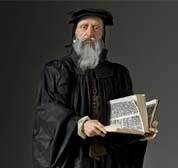
John Calvin

A man in Calvin’s congregation refused to repent of his sins and was consequently denied the Table of the Lord. Not feeling “welcomed,” the man complained to the Genevean Council. Ruling in the man’s favor, the council ordered Calvin to grant him the supper.

As the man, and his sword-bearing friends, began to approach the table on the following Lord’s Day, Calvin threw his arms over the table and proclaimed, “These hands you may crush, these arms you may lop off, my life you may take, my blood is yours, you may shed it; but you shall never force me to give holy things to the profaned, and dishonor the table of my God.”

How rude!

Apostle Paul

The Apostle Paul was definitely not very welcoming when it came to granting access to the Lord’s Table to those in sin. In the later portion of 1 Corinthians 11, Paul explains the significance of the occasion (vs. 23-26). He also explains the consequence of partaking in an unworthy manner, or not exercising proper discernment—the possibility of sickness and death ( vs. 27, 29, 30). For this reason, Paul tells us to examine ourselves (vs. 28). “But if we judge ourselves rightly, we would not be judged” (vs. 31).

Furthermore, Paul tells us that if we exercise proper discernment that we (believers) will not be “condemned along with the world” (unbelievers, vs. 32). Paul also points out that this simply isn’t another meal: “If anyone is hungry, let him eat at home, so that you will not come together for judgment . . .” Paul is certainly excluding unbelievers here. Ms. Manners would be scandalized!

Good Host/Bad Host?

So there you have it. You can follow Calvin’s and Paul’s example and guard the Table of the Lord, or you can follow pastor Hayford’s example and open the gates wide. A word of caution, though: If you decide to follow pastor Hayford’s example, I’d recommend that your church purchase extra insurance.

To gain a proper understanding of the Lord’s Supper, including who should and should not partake, I recommend reading questions and answers 75 through 82 of the Heidelberg Catechism.

--The Catechizer

Labels: , ,

Thursday, March 06, 2014

Baptism Resources

New Horizons magazine offeres two fine articles regarding baptism.

Baptism in Our Confessional Standards

In this article Rev. Alan D. Strange, professor at Mid-America Reformed Seminary, takes us through a guided tour of baptism in the Westminster Standards. Addressed are topics such as the . . .

  • Nature of baptism

  • Efficacy of baptism

  • “Improvement” of our baptism

You can read the entire article here.

A Better Case for "Infant Baptism"

In 2006, Rev. William Shishko, pastor of the Orthodox Presbyterian Church in Franklin Square, N.Y., debated Reformed Baptist and apologist Dr. James White: "Resolved: The subjects of Christian baptism are only those who have personally repented and believed in Jesus Christ as Savior and Lord."

Rev. Shishko explains the reason for the article this way: “The purpose of this article is to reflect on this debate. We can learn from projects like this, and become better able to respond biblically to those who differ with us.”

You can read the article here.

--The Catechizer

Labels: ,

Saturday, February 15, 2014

Clearing Up Sacramental Confusion

A great point is made over at the Green Baggins site regarding the sign and the thing signified in the sacraments:

One of the main difficulties in understanding the sacraments is understanding the relationship among these three elements of the sacraments. We’ll take baptism here for an example. The sign is the water, whether sprinkled, poured, or immersed (I believe that the amount of water used is ultimately immaterial). The thing signified is the cleansing blood of Christ. One important thing that is usually missed here is that the sacrament includes the thing signified. This gets at a huge problem in the church today. The church tends to refer to the sacrament as including only the sign. Therefore, when we use the term “baptism,” we usually mean just the sign, just the rite. However, this is not the only way to understand the sacrament. WLC 163 explicitly says that the “inward and spiritual grace thereby signified” is also part of the sacrament. This shouldn’t make us nervous in the least, because the real question is where the efficacy of baptism lies.

The power of baptism cannot lie in the sign. This is proven absolutely, 100% conclusively by Romans 4:11, which states explicitly that Abraham already had the thing signified long before he ever had the sign applied to him. Circumcision is described as a sign and seal. This refutes directly those who believe that the “seal” language implies conferral. For here in Romans 4:11 is a seal that most definitely could not confer something already possessed.

The thing signified obviously has saving power. The blood of Christ has an objectively saving power. But how does it get applied to us? The answer is in the sacramental union of sign and thing signified. Another way of describing this sacramental union is “Spirit-given faith.” This is how we avoid the problem that the Lutherans constantly have of ascribing saving power to baptism, and yet also saying “sola fide.” If it is Spirit-given faith that connects sign to thing signified, then that is faith alone that saves. Faith also connects the sign and the thing signified so that the whole sacrament is now present.

You can read the rest here.

--The Catechizer

Labels:

Thursday, October 04, 2012

Notable Quote: C.G. Kirkby

C.G. Kirkby on the sacraments . . .

Only two sacraments are known and administered by the Church in the New Testament era – Baptism and the Lord’s Supper. These are both equally signs and seals and intended to be attached to the Word. The word “sacrament” comes from the Latin term SACRAMENTUM and is equivalent to the Greek term MYSTERION which in the New Testament denotes the divine plan of salvation hidden in past ages but now brought to light in the preaching of the Word (Rom. 16:25, 26). They are called “mysteries” or “sacraments” because they have enabled men to participate in the mysterious union of God and man through the atoning death and resurrection of Christ.

It was Augustine who first gave the general definition of a sacrament, which later became traditional, as “an outward and temporal sign of an inward and enduring grace.” Accordingly to the catechism of the Book of Common Prayer, a sacrament is “an outward and visible sign of an inward and spiritual grace.” The Reformers insisted that the sacraments were given to the Word of God. This predominant purpose of a sacrament is for a sign and a seal. It is to declare to us what God has done for us and to us and within us..

Signs and Seals of the Covenant

Labels: ,

Monday, April 16, 2012

Come, Eat and Drink Judgment Upon Yourself!

Over at Christianity Today’s Web site (subscription required), popular pastor Jack Hayford of The Church on the Way fame offers a few ideas on how to make unbelievers feel more comfortable in church . . .

We invite all the people to gather around the Lord's Table and partake in small groups. We believe it is the Lord's Table we are invited to, the Lord is doing the inviting, and no one is excluded. To us that means unbelievers are invited, as well . . . we want people to know that they are welcome. For example, I might say, "If you are visiting with us today, you are not only welcome to participate, you are urged to. If you were at my house and it came dinnertime, I wouldn't leave you sitting in the other room while I went to the dining room . . .

It sounds as if pastor Hayford desires to be a good host. I’m sure that if I were invited to his dinner table he wouldn’t want to make me feel uncomfortable by telling me that there’s arsenic in the food and that I might get sick and/or die if I partake. No, that would be rude.

Unfortunately, not everyone is as thoughtful as pastor Hayford. Here’s two noted examples of inhospitality:

John Calvin

A man in Calvin’s congregation refused to repent of his sins and was consequently denied the Table of the Lord. Not feeling “welcomed,” the man complained to the Genevean Council. Ruling in the man’s favor, the council ordered Calvin to grant him the supper.

As the man, and his sword-bearing friends, began to approach the table on the following Lord’s Day, Calvin threw his arms over the table and proclaimed, “These hands you may crush, these arms you may lop off, my life you may take, my blood is yours, you may shed it; but you shall never force me to give holy things to the profaned, and dishonor the table of my God.”

How rude!

Apostle Paul

The Apostle Paul was definitely not very welcoming when it came to granting access to the Lord’s Table to those in sin. In the later portion of 1 Corinthians 11, Paul explains the significance of the occasion (vs. 23-26). He also explains the consequence of partaking in an unworthy manner, or not exercising proper discernment—the possibility of sickness and death ( vs. 27, 29, 30). For this reason, Paul tells us to examine ourselves (vs. 28). “But if we judge ourselves rightly, we would not be judged” (vs. 31).

Furthermore, Paul tells us that if we exercise proper discernment that we (believers) will not be “condemned along with the world” (unbelievers, vs. 32). Paul also points out that this simply isn’t another meal: “If anyone is hungry, let him eat at home, so that you will not come together for judgment . . .” Paul is certainly excluding unbelievers here. Ms. Manners would be scandalized!

Good Host/Bad Host?

So there you have it. You can follow Calvin’s and Paul’s example and guard the Table of the Lord, or you can follow pastor Hayford’s example and open the gates wide. A word of caution, though: If you decide to follow pastor Hayford’s example, I’d recommend that your church purchase extra insurance.

To gain a proper understanding of the Lord’s Supper, including who should and should not partake, I recommend reading questions and answers 75 through 82 of the Heidelberg Catechism.

Labels: , ,